Showing posts with label Caitanya Bhagavata. Show all posts

Friday, 7 February 2020

Nitai is Balaram


The many aspects of the eccentricity of Nityananda defeat the madness of illusory existence without the Lord.  Without Balaram we will believe the uniqueness of Maya. For the mercy of Lord Nityananda we can realize the existence of the Lord in  mantras. Balarama embodies the  quality of omnipresence of the Lord.  For the grace of Lord Nityananda we receive the Mahamantra and for His grace we hear it while we chant it.  By developing infinitesimally one quality of one  mouth of Ananta Sesa, Lord Balaram, we transcend the material energy.  The intent of the creation as enacted by Lord Balaram is spiritual. Lord balarama is in constant expansion through each sound which is uttered to glorify the Lord. Whatever form re-establishes the existence of the Lord is Balaram. Lord Balaram when manifests His lila in the material world is often furious because the refusal of the Lord, present only here, is the  challenge to Him, who is the very existence of the Lord.

"The Sesa who is the adhara-sakti (supporter-power) of the bedstead of Visnu (Wielder of the Sarnga bow), is in the category of God (Visnu-tattva).

The Sesa who bears the globes is an avesa-Avatara (absorption-avatara) of Krsna (or Sankarsana), and therefore He is (also) known as Sankarsana. The bedstead feature of Sesa always considers Himself to be an eternal servitor and friend of the Lord Sarngadhara (wielder of the Sarnga bow)."Bhaktisiddhanta S. Thakur


           Nitai is Baladev         (1)
without chess board
but with a love load
abandoning all rules
has become an avadhut.

Balaram is the throne,
the umbrella, the flute  
Nitai is the servant of Mahaprabhu,
Nitai is Baladev and Ananta Sesa,
with thousands mouths
chants "Hari Hari" in Gaudadesha;

Nitai is Balaram
the sustainer of the worlds
catches Nimai
who in love sways and falls, (2)
always by His sides
Nitai holds his crackedling throne. (3)
Nitai is Baladev, unarmed
shooting love through His glance
brings the river of prem,
without a plow in His hand;

Balaram constantly, repeatedly
expands in sound
Nitai graces all entities
with the Great Mantra
and the abilitity to hear it
as the Paramatma.

Balaram is Nitai, 
who carries a staff
His clothes are blue
wears one earring
and has become an avadhut.


Balaram has the gait of an elephant
reveals force and power
but Nitai, with the soft feet of a dancer 
intoxicated by sweetness, meanders;

Nitai is Balaram causing an ocean to rise
the heart cannot stop to dance and to cry
leaving the ego and the pride
to drown and die.

Nitai is Balaram the upholder of rules
but now is an avadhut.


1         1)    CC Adi 5.6 "That original Lord Kṛṣṇa appeared in Navadvīpa as Lord                       Caitanya, and Balarāma appeared with Him as Lord Nityānanda."
2)    ”As the powerful Nityananda caught hold of the Lord, Advaita secretly took the dust from the Lord’s feet.”  Caitanya Bhagavata MK 8.143
3)    “He (Caitanya) sat down upon Vishnu’s throne.  The seat crakled under His weight.  Nityananda quickly rushed to hold up.” Caitanya Bhagavata MK 8.283


Thursday, 2 February 2017

Nothing is as before


by Lakshmipati das (Italy)
This poem is a manifesto about the spiritual revolution that the appearance of Lord Gauranga Avatari brought about also within the context of the Vedic thought. He, as the Supreme Lord, disclosed the most revealing conclusions by asserting one fundamental principle that the goal is bhakti and the externals of religions are secondary.

This poetry was inspired by a prayer of Srila B R Sridhar Deva Goswami:

"At a time when religion was evaluated in terms of bodily relationship, saintliness was determined by ignorance, and yoga practice was motivated by sensual pleasure; when scholarship was cultivated just for voidism, japa was conducted for the sake of fame, and penance was performed out of vindictiveness; when charity was given out of pride, and on the pretext of spontaneous devotion the most gross, sinful acts were perpetrated - and in all such anomalous situations even the intelligentsia were at loggerheads with one another...." 

SB 10.23.43-44"...These women have never undergone the purificatory rites of the twice-born classes, nor have they lived as brahmacārīs in the āśrama of a spiritual master, nor have they executed austerities, speculated on the nature of the self, followed the formalities of cleanliness or engaged in pious rituals. Nevertheless, they have firm devotion for Lord Kṛṣṇa, whose glories are chanted by the exalted hymns of the Vedas and who is the supreme master of all masters of mystic power. We, on the other hand, have no such devotion for the Lord, although we have executed all these processes.”

Nothing is as before ~
divine love has been exposed,
religion is not something to long for
nor is liberation the scope;
heaven is not where eternality belongs
austerities may dry the soul,
saintliness is not what it appears on the surface
nor is measured by disciples and fame;
the Absolute Truth is no longer unnamed
or lost in the void,
knowledge no longer resides only
in logic and rhetoric,
temples are not places petrified in rites,
the hymns, echoing from stones
lost in the mist of time,
are no longer the swords of priests
to control the world,
when bereft of mercy
they fueled fears with holy curses;

Nothing is as before ~
the moon of Gauranga Avatari arose
and His moonlight has exposed
that liturgies harbor pride,
faithlessness is behind
enforced rules and roles,
no longer a means to reach God,
just meager profits on the altars
of evil and good,
of righteousness and virtue,
where bhakti never blooms;
charity, rituals, gender, caste and pride
are burning votive lamps
on materialist shrines
barren of devotion,
where compassion also dries
and also yoga fails
there is no determination
to contain the senses
nor to reach liberation;
the most Munificent Lord
came to deliver every soul,
to show the way beyond
spontaneous love was disclosed,
nothing is as arid and lacking of joy
as before,
bhakti 
is spontaneously and blissfully performed.
 love 
cannot be imposed.


Friday, 11 March 2016

Simultaneously in Goloka


This poem is the poetic rendition of a pastime of Lord Caitanya Mahaprabhu as narrated in Caitanya Caritamrta Madhya Lila 229-235 (See page n. for the whole story). It belongs to the category of poems related to my personal search for the continuity and simultaneous vision of the pastimes of the Lord as both Krishna and Caitanya Mahaprabhu.


CC Madhya Lila 11.221-224 "In His own pastimes in Vrindavana, when Krishna used to eat on the bank of the Yamuna, every gopa would perceive that Krishna was looking at him.
In the same way, when Caitanya Mahaprabhu observed the dancing, everyone saw that Caitanya Mahaprabhu was facing him.
When someone came nearby while dancing, Sri Caitanya Mahaprabhu would tightly embrace him." 
"Upon seeing the great dancing, great love and great sankirtana, all the people of Jagannatha Puri floated in an ecstatic ocean of love."

Jaiva Dharma Ch.17   "Then there are devotees who in their period of sadhana worship both Sri Krishna and Sri Gauranga. After obtaining liberation they acquire two transcendental forms and serve Sri Krishna in Krsna-pitha and Sri Gauranga in Gaura-pitha simultaneously.  This is the divine and confidential mystery of the inconceivable, simultaneous oneness and difference of Sri Krishna and Sri Gauranga.


Radiant like the air
at dusk,
the sweetest Lord,
with as much rice
as His hand could hold,
filled each plate.
In a row everyone sat 
and after Him, they ate,
then amidst them
He started to dance
and any shadows were dispelled;

From the blue town
people flocked
and crowded around,
as the sweeping waves of love
crashed Him to the ground,
while an ocean of tears
washed upon and drowned
the shore-like eyes
of all who came nearby.
Anyone close to the Lord,
within the reach
of His limbs,
was embraced by Him,
and all the dancers
in all directions,
and the singers
 on all sides, near and far,
everyone who was present,
met his eyes
in the same moment,
and each one,
at the same time,
felt to be the only one
beheld by that glance. 

O reader, now please
see this same scene,
the same youth,
but with blue skin
 as He sat on a rock,   (1)
in the blossoming of spring,
yogurt and rice in His hand
  and dates to share  (2)
with His friends.
While they ate
He gazed at them
one on one,
facing each friend,
eye to eye
in the same moment,
and each one felt
at the same time
to be the only one
beheld by His glance.

And so, in the way
only the soul can
walk into Vraja and Navadvip
at the same time,
because in the spiritual realm
the two sacred places
simultaneously exist,
here it is difficult to conceive,
there just one chord weeps
 in separation and in union ~
this is the secret gift
of the Golden Lord appearing in Navadvip.


________________________________
(1) Gopala Campu “In the monsoon, Krishna with his friends takes shelter under a tree to avoid the rain and eats dates grown in beautiful valleys.  He sits on a stone slab near the water eating rice mixed with yogurt and calls the cows that are far away.  These activities attract our [Gopi's] hearts.”
(2) SBB 5.30 Comm. "Holding in His hand a very nice preparation of yogurt and rice, with pieces of suitable fruit between His fingers, He sat like a the whorl of a lotus, looking forward toward all His friends ..."

Sri Caitanya Caritamrta Madhya Lila 11. 229-235 
.... in the middle of them the Lord Himself, known as the son of mother Saci, began to dance.(215)
When the tumultuous vibration of sankirtana resounded, all good fortune immediately  awakened ...(217)
When the congregational chanting began, ecstatic love immediately overflooded everything, and all the residents of Jagannatha Puri came running.(218)
(229-235):
When Sri Caitanya Mahaprabhu fell down to the ground, Sri Nityananda Raya Prabhu lifted Him up.
The tears from the eyes of the Lord came out with great force, like water from a syringe. Indeed, all the people who surrounded Him were moistened by His tears.
While kirtana was going on, there was a transformation of ecstatic love and much tears, jubilation, trembling, perspiration and deep resounding in the body of Sri Caitanya Mahaprabhu. Upon seeing this transformation, all the people present became very much astonished.
While this dancing was going on, Sri Caitanya Mahaprabhu watched them and performed a miracle. 
Sri Caitanya Mahaprabhu stood in the middle of the dancers, and all the dancers in all directions perceived that Sri Caitanya Mahaprabhu was looking at them.
Wanting to see the dancing of the four great personalities, Sri Caitanya Mahaprabhu exhibited this miracle of seeing everyone simultaneously.

Everyone who saw Sri Caitanya Mahaprabhu could understand that He was performing a miracle, but they did not know how it was that He could see on all four sides.


Monday, 1 February 2016

Lamentation of Vishnupriya-devi


Bhakti Ratnakara Chapter 4 :"Because of separation from Caitanya, she never slept at night. If at all she slept, she would lie on the hard ground.
Her golden complexion had grown pale like the new moon. While chanting the names of Hari, she would set aside a grain of rice for each mantra.  Later in the day, only those grains would be soaked and offered to the Lord.  The offering was very small, and yet she would eat only a portion of it. "

Vishnupriya devi Thakurani lived her life in the slow burning agony of separation from Sri Gouranga after His departure. Nor would anyone ever hear her voice.  Constantly shedding tears .....


My heart walls in
a labyrinth of lamentation
where time is marked
by the fall
of a grain of rice
into a bowl,
then soaked in tears
that swell and drop
endlessly
from inner silent corners, 
where nothing else exists
but Your name
flowing in a stream,
there the chanting, the divine love
any instant of You -
abides,
 keeps me alive,
yet oblivious to life.
and You come in dreams  (1)
bathed in autumn moonlight
Your words my only delight;
neither the sun
nor the moon
giver of rest,
will ever rise
in this continuous sunset
of your absence,
and in this numbness
of my being
I lie on the bare ground
of my barren life;
time was meaningful before,
because of You,
when You ate, You slept or bathed,
what a piercing of the heart
this passing of the hours,
 no one has ever lived
without even
the slightest hope
of Your return!


(1) The dream by Sri Vishnupriya-devi BR Ch. 4 "Just then Sri Vishnupriya-devi was telling her favorite maidservant that she had had a dream, which she would describe.  Her Lord, who was the attractor of the entire creation, had appeared before her in an enchanting pose.  [...]  In his affectionate way, Caitanya made Visnupriya sit down, and he spoke to her in a soft sweet voice : ' A brahmana boy named Srinivasa has suffered indescribably.  Today he will come to see you.  Knowing him to be a dear devotee, you should bestow your mercy on him.'  Caitanya continued to delight her with his pleasing words and then suddenly disappeared, and she awoke in distress."

Friday, 27 February 2015

ALLEGRETTO for Navadvip


CC Adi Lila 14.3 “I have thus described in brief the advent of Śrī Caitanya Mahāprabhu, who appeared as the son of mother Śacī, exactly as Kṛṣṇa appeared as the son of mother Yaśodā.”

Sri Navadvipa-dhama Mahatmya  “You should know that all the pastime places of Vrndavana are situated within this place. Make no distinction between Vrndavana and Navadvipa, nor between Gouranga and Krsna" -
excerpted from 

This poem was inspired by the poetry: "The holder of the flute now carries a danda"
by the medieval Gaudiya Vaishnava poet Balaram Das
ref. Sri Krishna Karnamrita  No9 - pg.34


There is continuity in the Lord’s pastimes and by the mercy of Lord Caitanya, His devotees simultaneously reside in Vraja and Navadvip absorbed in the Lord's pastimes within their hearts.  This poem unfolds this meditation. 

Saturday, 1 March 2014

UNTOLD LOVE

"The Lord's charming looks overshadowed the attractiveness of millions of cupids put together.
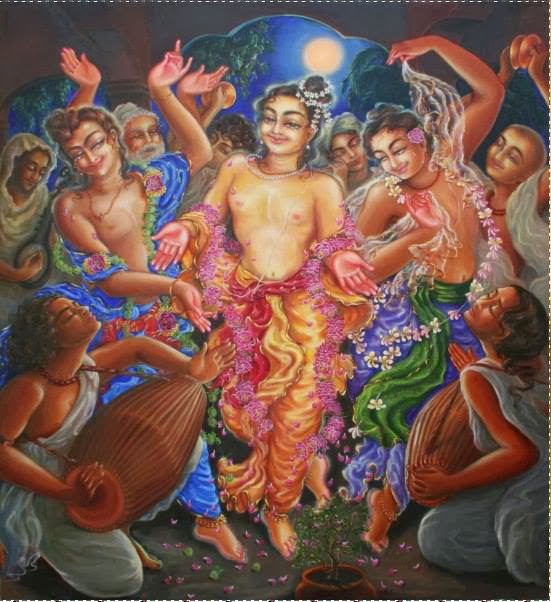
 I am at a loss to find the appropriate similes to describe the Lord's beauty yet I venture to do so only by His mercy alone otherwise who can dare to attempt such an impossible task. He glowed like a mountain of gold, His body being smeared with sandal paste sometimes looked like the rising full moon. His curly dark tresses were decorated with the fragrant Malati garlands; a sweet smile clung intimately to His lips that can win the heart of all the muses.  The clear markings of sandalwood tilak with a red dot of Vermilion adorned His beautiful broad forehead. He raised His arms up in the sky chanting the name of Hari and danced; the knee long flower garland around His neck swayed with each movement. His upraised arms glistened like fine tapering pillars of gold, His body became drenched with the incessant flow of ecstatic tears from His lotus petal eyes. As the ecstatic feelings increased the hairs of His body stood on end like the ever fresh Kadamba flower. Chaitanya Bhagavata MK 23 ch. 

Friday, 28 February 2014

PILGRIM OF LOVE


This poem celebrates the dancing of Lord Caitanya amidst His devotees. It is to celebrate the Gour Purnima festival when the Sankirtan Movement manifests the vision of Lord Nityananda.  It celebrates the descent of the Holy Names in this degraded age, the unique dancing and tears of this incarnation of the Lord of matchless glories.   It celebrates this special land of Gaudadesh, Mayapur, where Lord Caitanya, the Golden Avatar, has attracted crowds, in millions, in billions to chant and dance in ecstatic love which flows uninterrupted from His munificent personality. It celebrates the gold of this appearance of the Lord, the golden of His complexion, the golden love of Radha and celebrates all the devotees that come to this land as pilgrims of this love, even if just only in their heart, casket of this treasure.

So, inspired by a chronicle (Caitanya Bhagavata AnKI 3.381-439) of the time describing one of the many occurrences when myriads of people moved across this land to meet the Golden Lord, this poem draws a parallel into modern days through a true  prophecy of the time –in the poem foretold by an imaginary character “the pilgrim of Kuliya” (Kuliya = the present Navadvipa) - that people from all over the world will gather to this place to get this inestimable gift of devotion. 
Bards and Poets!
Give up tales
of golden cities 
and magic lands
and sing instead of Gaudadesh!
As the pilgrim of Kuliya has told,
 at one time there
arose the Sun and the Moon, 1
predicting a golden age.

Hear of the Golden Lord
the pilgrim of Kuliya saw,
who once was in that land
when He walked upon this Earth.
People in millions set forth, 
crossing meadows, forests and waters,
to search for the gold 
 of that Divine Love,
and to see for themselves the golden hue of His limbs
that no one had seen before!
As hundreds of thousands of choruses,
and multitudes of voices echoed prayers and cheers,
the pilgrim of Kuliya recalled an ocean formed, 
no doubt filled by love's tears;
Because  myriads chanted the Name of Hari
the  jewel of refulgent love, 
Goura Avatari came
 amidst that delirious crowd,
and soft as a saffron cloud,
danced hardly touching the ground,
chanting Krishna’s names
 pure love abounded in all parts,
flowing from His person,
to everybody's hearts.

For thousands of years to come,
the pilgrim of Kuliya foretold,
many will gather together
to partake eagerly of that gold,
more people than you can imagine
from all countries and all races,
will come to this land
in festive crowds, to a festival of raised hands,
and in a feast of cheers shouting “Hari Hari”
for a drop of that aurous mercy,
 in raptures during the chant
He will appear to dance,
pouring out love as fluid gold
on the iron cage of the soul.

These words I repeat as I heard them
from the pilgrim of Kuliya,
my heart sings and dances
like a pilgrim of love
returning again in the midst of that crowd,
 calling to the Golden Lord 
for a spark of that gold,
 I beg for His love chanting "Hari Hari"
 and all at once - as if by a spell,
 I’m there in Gaudadesh.


1)       SB 12.2.24When the moon the sun and Brhaspati are together in the constellation Karkata and all three enter simultaneously into the lunar mansion Pusya- at that exact moment the age of Satya or Krta will begin”. 


The land of Gaudadesh is the cone of light irradiating the night when all around is enveloped by deep darkness.  In this night of the soul the Golden Lord of Love appeared in this holy land causing this cone of light by the chanting of the Holy Names and hundreds of thousands of hearts were submerged by the resplendence of His Divine Love.
 This land is forever trampled by the whirling steps of the ecstatic dances of Lord Gouransundara, and millions ever since come to this land to receive a drop of that love.  The kirtans, the cheers,  the acclamations, the chanting, the name of Hari always resound on this land filling the hearts with devotion because the Golden Lord never leaves this place and dances among His devotees bestowing Bhakti.  So compare to the gold of the form of Lord Caitanya, the mundane gold and wealth has no value and loses its attractiveness.  Love and devotion is the gold of the soul, the liquid to quench its thirst for Divine Love.
So inspired by a chronicle of the time describing one of the many occurrences when myriads of people moved across this land to meet the Golden Lord, this poem draws a parallel into modern days through a true  prophecy of the time –in the poem foretold by an imaginary character “the pilgrim of Kuliya” ( Kuliya = the present Navadvip) - that people from all over the world will gather to this place to get this inestimable gift of devotion.
So my heart becomes a pilgrim of love wandering in remembrance of this special land and the magic spiritual stories of when the Munificent Lord walked on this land.